

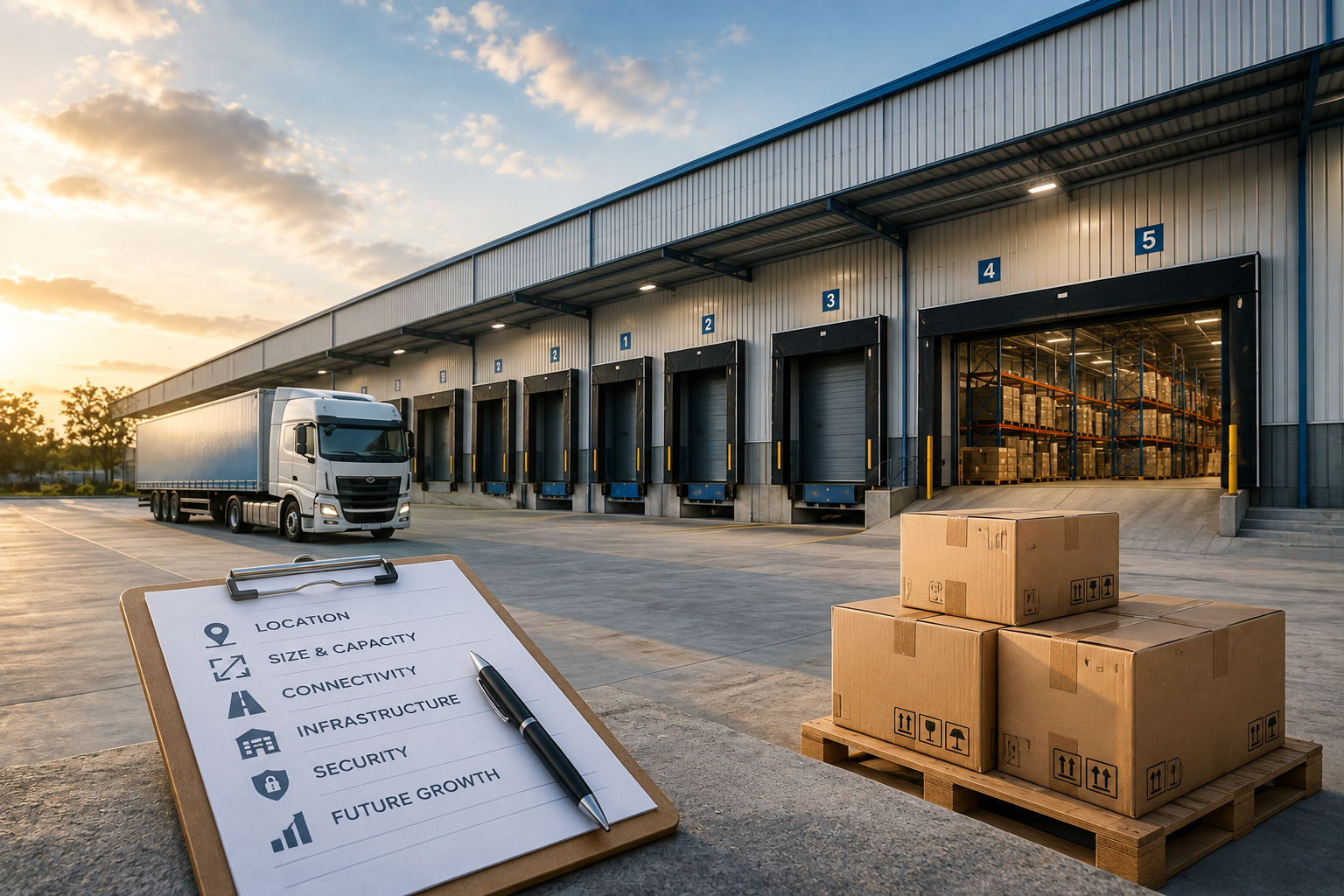
Leasing a warehouse is an important business decision, especially for companies involved in manufacturing, distribution, logistics, e-commerce, retail supply chains, and inventory management. A warehouse is not simply a place to store goods—it can directly influence operating costs, delivery timelines, inventory movement, workforce efficiency, and the ability of a business to expand.
The right warehouse should therefore be evaluated from both an operational and financial perspective. A property may look attractive because of its size or rental price, but factors such as location, road connectivity, loading facilities, internal layout, infrastructure, utilities, safety, lease terms, and future requirements can significantly affect its practical value.
If you are planning to lease a warehouse in Jaipur, understanding these factors before signing a lease can help you make a more informed decision and avoid operational difficulties later.
1. Start With Your Business Requirements
Before searching for a warehouse, clearly define what your business actually needs. Different businesses have very different warehousing requirements.
A company focused on e-commerce fulfilment may need efficient inventory movement, multiple loading points, vehicle accessibility, and sufficient space for sorting and dispatch. A manufacturing business may require a warehouse close to its production facility, while a logistics company may prioritize highway connectivity and easy movement of commercial vehicles.
Consider factors such as:
- Required storage capacity
- Approximate warehouse area
- Type and volume of goods
- Number and size of vehicles accessing the property
- Loading and unloading requirements
- Number of employees
- Need for office or administrative space
- Storage height requirements
- Electricity and water requirements
- Need for open-yard space
- Future expansion plans
Having these requirements defined before beginning the search makes it easier to filter unsuitable properties.
2. Location and Connectivity Matter
Location is one of the most important factors when leasing a warehouse. A strategically located property can make transportation and distribution more efficient, while a poorly connected warehouse can increase travel time and operating costs.
When evaluating a warehouse location, consider its accessibility to major roads, highways, industrial areas, markets, suppliers, customers, and other important business destinations.
For businesses operating around Jaipur, locations such as VKI, Sitapura, Mahindra World City, Bagru, Ramchandrapura, 22 Godown, and other industrial and logistics corridors may offer different advantages depending on the nature of the operation.
However, the best location is not necessarily the most prominent one. It should be the location that provides the right balance between accessibility, operating requirements, rental cost, workforce availability, and long-term business needs.
3. Evaluate the Warehouse Size Carefully
Choosing the right warehouse size requires more thought than simply estimating the amount of inventory you currently have.
The available space should accommodate inventory while also leaving sufficient room for movement, sorting, loading, unloading, equipment, employees, and other operational activities.
A warehouse that is too small can create congestion and restrict business operations. On the other hand, leasing significantly more space than required can result in unnecessary rental and maintenance expenses.
Consider not only the present requirement but also expected business growth during the lease period. If inventory volumes are likely to increase, having some additional capacity can provide valuable flexibility.
4. Check the Internal Layout and Usable Space
Two warehouses with the same built-up area may offer completely different levels of operational efficiency.
The internal layout should support the way your business receives, stores, moves, and dispatches goods. Check the positioning of storage areas, loading points, columns, doors, circulation paths, office spaces, and other structural elements.
Important considerations include:
- Clear internal movement areas
- Column placement
- Floor condition
- Storage configuration
- Ceiling height
- Entry and exit points
- Loading areas
- Internal vehicle movement
- Space for material-handling equipment
The usable operational area is often more important than the total quoted area.
5. Assess Loading and Unloading Facilities
Loading and unloading are central to warehouse operations. If vehicles cannot approach the warehouse efficiently, even a well-located property can become operationally inconvenient.
Check whether the property can accommodate the types of vehicles used by your business. Consider the width of access roads, turning radius, loading bays, docking arrangements, loading platforms, and space available for vehicles to wait or manoeuvre.
For businesses handling frequent dispatches, these details can have a direct impact on daily efficiency.
6. Examine Road Access and Vehicle Movement
A warehouse may be located close to a major highway but still have poor last-mile access.
Before finalizing a property, inspect the actual route leading to the warehouse. Consider road width, turning points, traffic conditions, nearby development, restrictions on heavy vehicles, and the condition of the approach road.
If your business depends on regular movement of trucks or other commercial vehicles, vehicle accessibility should be evaluated during an actual site visit rather than relying only on a map location.
7. Check Infrastructure and Utilities
Warehouse operations often depend on reliable basic infrastructure.
Before leasing, understand what facilities are already available at the property and what may need to be arranged separately. Depending on your business, this can include:
- Electricity connection and available load
- Water supply
- Drainage
- Internal lighting
- Ventilation
- Internet and communication connectivity
- Fire-safety infrastructure
- Security arrangements
- Parking
- Waste-management facilities
If specialized infrastructure is required for your operation, confirm its availability and feasibility before entering into the lease.
8. Consider Storage Height and Structural Specifications
For many warehouse businesses, the vertical space of a building can be as important as its floor area.
A warehouse with adequate clear height can provide better storage efficiency, particularly where racking systems are used. However, the suitability of the structure depends on the nature of the stored goods and the proposed storage system.
Review factors such as clear height, roof condition, flooring, structural capacity, ventilation, natural lighting, and suitability for storage racks or equipment.
9. Inspect the Condition of the Property
A warehouse should be physically inspected before the lease is finalized.
During the visit, look for signs of water leakage, damaged flooring, structural deterioration, poor drainage, inadequate lighting, ventilation issues, or other conditions that could affect operations.
Do not rely entirely on photographs or property descriptions. A physical inspection gives you a better understanding of the actual condition and usability of the premises.
10. Understand Safety and Security Arrangements
The safety of inventory, employees, equipment, and the property itself should be considered before leasing.
Depending on the warehouse and nature of operations, review available security measures such as boundary walls, gates, access control, CCTV provisions, security personnel, lighting, and emergency access.
Fire-safety arrangements should also be evaluated according to the property’s use and applicable requirements. Where specific approvals, installations, or compliance measures are required, these should be clarified before occupying the premises.
11. Calculate the Total Occupancy Cost
Rental value is only one part of the cost of leasing a warehouse.
Before making a decision, understand the complete financial commitment associated with the property. This may include rent, security deposit, maintenance, utilities, property-related charges, taxes where applicable, common-area charges, insurance, fit-out costs, and other agreed expenses.
A warehouse with a lower monthly rent may not necessarily be the more economical option if it involves significantly higher transportation, maintenance, infrastructure, or modification costs.
Comparing the total occupancy cost gives a more realistic picture of affordability.
12. Read the Lease Terms Carefully
The lease agreement defines the commercial and operational relationship between the property owner and tenant. Important terms should be understood before signing.
Pay attention to:
- Lease duration
- Monthly rent
- Security deposit
- Rent escalation
- Maintenance responsibilities
- Utility payments
- Permitted use
- Repair responsibilities
- Alteration and fit-out permissions
- Renewal conditions
- Notice period
- Termination provisions
- Subleasing or assignment provisions
- Possession conditions
If any clause is unclear, it should be discussed and reviewed appropriately before execution.
13. Confirm the Permitted Use
A warehouse should be suitable for the intended business activity from both a practical and regulatory perspective.
Do not assume that because a property is described as a warehouse, every type of commercial, industrial, storage, manufacturing, or processing activity can automatically be conducted there.
The intended use should be checked against applicable land-use regulations, zoning requirements, permissions, and other relevant approvals. Where necessary, obtain professional legal or regulatory advice before finalizing the lease.
14. Think About Workforce Accessibility
Warehouse operations depend on people as much as they depend on infrastructure.
Consider whether employees, supervisors, drivers, and support staff can reasonably reach the location. Availability of public transportation, surrounding development, nearby residential areas, and overall accessibility may influence workforce convenience.
This can become particularly important for businesses operating multiple shifts.
15. Consider Future Expansion
Your warehouse requirement today may not remain the same throughout the lease period.
If your business is growing, consider whether the property can support future expansion. This could mean additional warehouse space within the same premises, adjacent open land, nearby properties, or flexibility in the lease arrangement.
Planning ahead can reduce the disruption and expense involved in relocating when the business outgrows the existing facility.
16. Compare Multiple Properties Before Deciding
One of the most effective ways to make a better leasing decision is to compare several suitable properties rather than selecting the first available option.
Create a practical comparison based on:
| Factor | What to Evaluate |
|---|---|
| Location | Connectivity and proximity to important business routes |
| Size | Built-up and usable operational area |
| Accessibility | Road access and vehicle movement |
| Infrastructure | Power, water, drainage and other facilities |
| Layout | Storage, movement and loading efficiency |
| Condition | Building quality and maintenance |
| Cost | Rent and total occupancy expenses |
| Lease Terms | Tenure, escalation, deposit and responsibilities |
| Permitted Use | Suitability for intended operations |
| Future Needs | Expansion and long-term requirements |
This helps shift the decision from “Which warehouse looks best?” to “Which warehouse works best for our business?”
17. Conduct Proper Due Diligence
Before entering into a lease, relevant property and documentation should be reviewed carefully.
Depending on the transaction, this may include verifying ownership, authority to lease the premises, property documentation, permitted use, applicable approvals, existing encumbrances or restrictions, and other relevant legal matters.
Businesses should undertake appropriate due diligence and seek advice from qualified legal and professional advisors where required.
18. Plan the Fit-Out and Moving Process
Even when a warehouse is ready to occupy, your business may require modifications before operations begin.
You may need to install storage racks, partitions, office areas, security systems, lighting, equipment, signage, or other operational infrastructure.
Before signing the lease, understand what alterations are permitted, who will bear the cost, whether owner approval is required, and what happens to installed fixtures when the lease ends.
Planning these details in advance can prevent delays during the transition.
Making the Right Warehouse Leasing Decision
Choosing a warehouse should not be based on rent or location alone. The right warehouse is one that supports your business operations efficiently while remaining commercially practical over the lease period.
Location, accessibility, size, layout, infrastructure, loading facilities, safety, total cost, lease terms, permitted use, and future requirements should all be considered together. Taking the time to evaluate these factors before committing can help businesses reduce operational complications and make a more informed real-estate decision.
At Anita Associates, we help businesses looking for warehouse space in Jaipur understand their requirements, identify relevant properties, compare suitable options, coordinate site visits, and navigate the leasing process. Our approach focuses on finding warehouse solutions that align with the operational, location, size, budget, and long-term requirements of each business.
Whether you need a warehouse for storage, distribution, logistics, manufacturing support, e-commerce fulfilment, or another permitted business purpose, a structured property search can make the process more efficient and focused.